


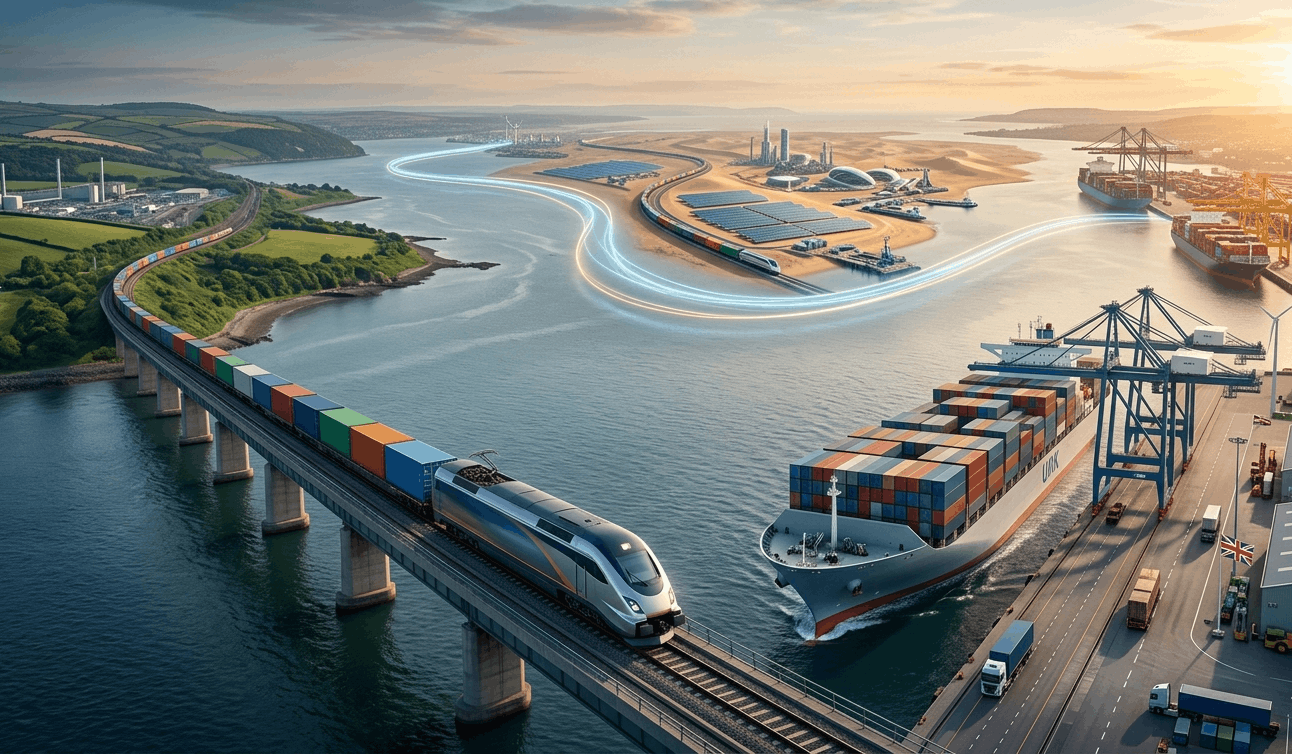
The Future of UK-India Trade is Being Built Today
Global trade is changing quicker than ever. Geopolitical unpredictability, supply chain interruptions, and the need for more resilient logistics networks have spurred governments and businesses to reconsider how goods are transported around the world.
Against this backdrop, the India-Middle East-Europe Economic Corridor (IMEC) has emerged as one of the most ambitious global infrastructure projects in decades. The corridor, announced during the G20 Summit in New Delhi in September 2023, proposes to connect India and Europe via the Middle East by an integrated network of ports, trains, shipping lanes, digital infrastructure, and sustainable energy systems.
For UK firms, IMEC is much more than a geopolitical initiative. It has the potential to alter supply chains, open up new export opportunities, and deepen economic connections with one of the world’s most rapidly expanding major economies.
According to the UK government, the recently signed UK-India Free commerce Agreement is predicted to boost bilateral commerce by £25.5 billion per year in the long run, adding £4.8 billion to the UK economy.
As trade policy and infrastructure evolve concurrently, UK businesses who plan early may be better positioned to benefit from this changing scenario.
What Is the India-Middle East-Europe Economic Corridor (IMEC)?
IMEC is a transnational plan announced in September 2023 at the G20 Summit in New Delhi that aims to connect India, the Middle East, and Europe with an integrated network of ports, trains, shipping routes, digital infrastructure, and energy corridors.
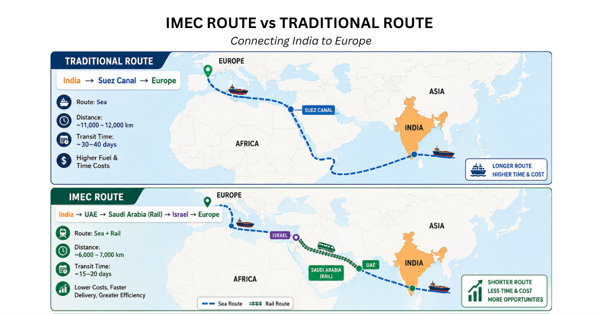
Unlike traditional maritime trade routes, which rely heavily on ocean freight, IMEC intends to build a multimodal transport network that combines sea and rail connectivity to improve efficiency and resilience.
The corridor is expected to establish a new economic link between some of the most strategically significant markets in the world by linking India with the United Arab Emirates, Saudi Arabia, Jordan, Israel, and Europe. Stronger access to European markets and deeper integration into global supply chains will benefit India’s economy, while Saudi Arabia and the United Arab Emirates may become even more important hubs for trade, investment, and logistics as they expand beyond oil. Better supply chain resilience, more market access, and new prospects in manufacturing, infrastructure, technology, and professional services might all be advantageous to European economies, including the UK.
But transporting things from one location to another is only one aspect of IMEC. It has the potential to change the locations of economic value creation throughout the region by establishing alternate trade routes and drawing investment into new logistical and industrial clusters.
Established routes like the Suez Canal may see more competition as companies look for more diverse supply chains, even if they are unlikely to be replaced. Following the Ever-Given blockade in the Suez Canal in 2021 and recent interruptions in the Red Sea, which highlighted the dangers of depending solely on one trade corridor, the significance of other trade routes has become more evident. IMEC provides an alternate route that could lower supply chain risks, increase resilience, and give more flexibility, even if it is not anticipated to replace the Suez Canal. As the corridor grows, companies and nations who start forming alliances and strengthening their supply chains around IMEC now will probably be in a better position.
In the end, the nations and companies that establish themselves early in this developing trade ecosystem are probably going to be the largest winners.
Why IMEC Matters for UK Businesses
The discourse around IMEC goes well beyond logistics. It mirrors a larger transition in global trade, in which resilience, diversification, and strategic relationships are becoming equally vital as cost efficiency.
The previous five years have shown how susceptible worldwide supply chains may be. Pandemic-related shutdowns, shipping bottlenecks, and delays on important maritime routes have compelled firms to reconsider their sourcing and distribution strategy.
Against this backdrop, IMEC provides a chance to create more flexible and robust supply chains while also strengthening economic ties between Europe, the Middle East, and India.
For UK businesses, this might imply faster access to growing markets, better sourcing options, and less susceptibility to single-route disruptions.
The Perfect Timing: IMEC Meets the UK–India Free Trade Agreement
Infrastructure alone does not generate economic growth. Infrastructure paired with beneficial trade policy works. The newly completed UK-India Free Trade Agreement is expected to dramatically strengthen economic connections between the two countries.
The UK government estimates that the agreement will:
- Increase bilateral trade by £25.5 billion per year in the long run.
- Add £4.8 billion to UK GDP.
- Increase UK exports by almost £15.7 billion per year.
- Tariffs should be reduced in a variety of areas while customs procedures are simplified and digital trade is supported.
Industries Most Likely to Benefit from IMEC
As IMEC strengthens trade links between India, the Middle East, and Europe, several sectors are well positioned to benefit from increased investment, improved connectivity, and evolving supply chains.
Manufacturers may be able to access rapidly expanding markets with better connectivity, while exporters and logistics companies may experience higher trade volumes and more varied supply chains. As investment in IMEC-related projects increases, companies with expertise in supply chain technology, digital infrastructure, engineering, and renewable energy are also anticipated to play a significant role.
Several sectors are particularly well placed for growth:
- Advanced Manufacturing: Manufacturers may be able to expand into new markets, diversify their supply chains, and increase their export prospects with better connectivity.
- Aerospace: UK aerospace companies may profit from rising demand for parts, engineering know-how, and maintenance services as India’s aviation industry continues to grow.
- Clean Energy: Considerable funding for green hydrogen and renewable energy projects in IMEC nations may open doors for UK companies assisting in the energy transition.
- MedTech: Growing healthcare investment in the Gulf and India may increase demand for specialized equipment, cutting-edge medical technology, and healthcare innovation.
- Engineering Services: Since IMEC is centered around ports, railroads, energy networks, and digital infrastructure, engineering and consulting businesses will probably be crucial to the completion of significant projects.
Competition is also anticipated to increase as new hubs for trade and logistics appear throughout India and the Gulf. As global trade patterns change, companies that put off diversifying their supply chains, investing in digital capabilities, or forming regional partnerships run the danger of falling behind. Conventional transit routes and well-established logistical networks may come under greater strain.
How IMEC Could Reshape UK Supply Chains
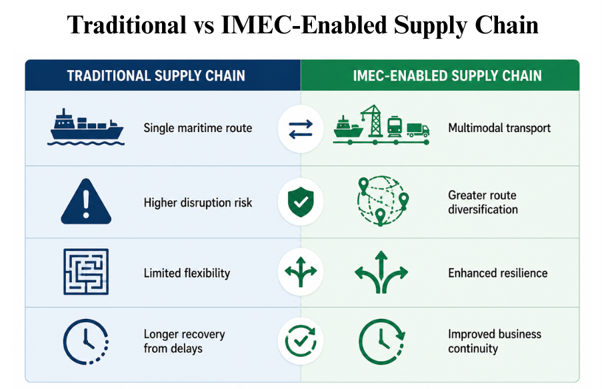
Supply chain resilience has become a top boardroom focus. Businesses are increasingly balancing cost and continuity, realising that diversity is critical in an unpredictable trading environment. IMEC has the ability to facilitate this transition by expanding transportation options and enhancing regional connections.
The potential commercial benefits include:
- Increased supply chain resilience
- Better access to other suppliers.
- Enhanced logistical flexibility
- Improve inventory planning.
- Reduced reliance on single shipping routes.
Recent global events have highlighted why diversification is now a business necessity:
- COVID-19 Pandemic: Factory shutdowns and semiconductor shortages have impacted industries such as automotive, electronics, healthcare, and manufacturing, highlighting the dangers of relying too much on concentrated supply chains.
- Suez Canal Blockage (2021): The Ever Given incident delayed over 12% of global trade, resulting in shipping bottlenecks, increased freight prices, and extensive supply chain disruption.
- Middle East Conflict & Red Sea Disruptions (2023–25): Regional tensions, including attacks on commercial shipping and the deepening of the Iran-Israel conflict, prompted many ships to avoid the Red Sea and Suez Canal, lengthening passage times, increasing freight prices, and putting strain on global supply networks.
Challenges Ahead-
IMEC has the potential to change international trade, but a number of obstacles could limit how quickly and widely it develops. Obstacles include ongoing geopolitical tensions in the Middle East, the difficulty of coordinating several nations and regulatory systems, possible delays in the supply of infrastructure, and the substantial money needed for large-scale projects. Because of this, companies should see IMEC as a long-term strategic opportunity whose success will rely on both ambition and ongoing political and economic cooperation.
A Significant Opportunity for UK Exporters
In addition to creating future trade prospects, the UK-India Free Trade Agreement and enhanced connection through IMEC also give firms a chance to get ahead of the competition.
As trade volumes rise and investment flows quicken throughout the corridor, businesses that build supply chain alliances, distribution networks, and market presence early on are probably better positioned to profit.
Opportunities for UK exporters are anticipated in a number of industries, including innovative engineering solutions, medical equipment, aerospace components, industrial gear, and renewable energy technologies. Major infrastructure projects will also probably increase demand for professionals with experience in engineering, cybersecurity, sustainability, finance, legal services, and digital transformation.
In addition to creating future trade prospects, the UK-India Free Trade Agreement and enhanced connection through IMEC also give firms a chance to get ahead of the competition.
Five Strategic Actions UK Businesses Should Take Now
While many IMEC projects will take years to complete, planning should begin well before the first shipment moves.
Businesses can improve their positions by:
- Examining current supply chain linkages and identifying places where diversification could help decrease risk.
- Exploring supplier and collaboration opportunities in India’s expanding industrial environment.
- Assessing export readiness for the Indian and Middle Eastern markets.
- Investing in digital supply chain visibility and automation allows for greater flexibility as global networks expand.
- Monitoring infrastructural and policy developments to detect emerging business opportunities ahead of competition.
History frequently demonstrates that organizations that adapt quickly to structural shifts in global trade outperform those that wait.
Looking Beyond Logistics: IMEC as a Long-Term Growth Strategy
It’s easy to dismiss IMEC as yet another transportation project. In actuality, it highlights a broader trend toward more connected, digital, and resilient global trade networks.
As firms pursue diversity and regional alliances, programs like IMEC are expected to have long-term implications for investment decisions, sourcing strategies, and international expansion plans. The opportunity for UK companies goes beyond simply moving goods faster; it is to become a part of a new economic ecosystem that connects Europe, the Middle East, and India.
Ready to Explore New Trade Opportunities?
As trade corridors evolve and UK-India economic ties strengthen, businesses that plan early will be best positioned to capture emerging opportunities.
At Technovedge, we help UK businesses turn opportunity into action through:
- Market entry and expansion strategies for India
- Partner identification and ecosystem building
- Supply chain diversification and resilience planning
- India sourcing and procurement strategies
- UK–India business expansion and growth advisory
Our team can assist you in navigating the opportunities that are growing throughout the UK-India corridor, whether you’re investigating new markets, forming strategic alliances, or streamlining your supply chain.
🔗 Follow us on LinkedIn for ongoing UK–India technology insights.