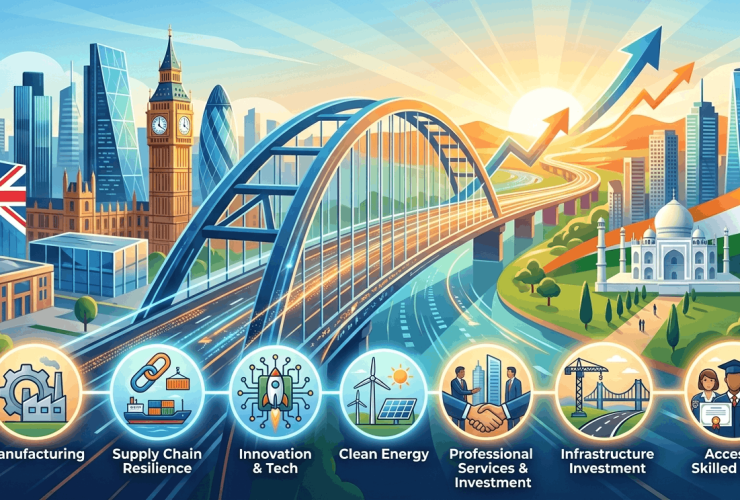



India is making a greater push to attract overseas investment. Could this provide a new opportunity for UK businesses?
On August 21, 2026, news surfaced that India is considering creating a special “Green Channel” for UK and European investors. The proposed method would provide targeted support to businesses, assisting them in navigating government approvals and addressing regulatory or administrative bottlenecks. It is apparently being discussed in conjunction with India’s existing Japan Plus and Korea Plus arrangements.
For UK businesses, timing is critical. The UK-India Free Trade Agreement (FTA), also known as CETA, went into effect on July 15, 2026, providing a stronger framework for trade between the two nations. The focus is now turning from simply trading with India to investing, establishing operations, and fostering long-term market growth.
What Could the Proposed Green Channel Change?
The proposed Green Channel aims to provide a more formal route for UK and EU companies seeking to invest in India.
Rather than leaving international investors to handle several government offices and approval processes alone, the suggested approach may provide:
- Reduce approval timelines
- Cover all sectors or only selected industries
- Include minimum investment thresholds
- Operate only through central government authorities
- Support state-level approvals
- Apply to greenfield investments, brownfield investments, JVs, and subsidiaries.
It is crucial to emphasize that the Green Channel is currently being considered as a proposal rather than an actual fast-track investment project.
That distinction is important for businesses considering India today.
The opportunity does not merely involve waiting for a new program. It is about acknowledging the overall direction of India’s investment strategy.
Why Does This Matter for UK Businesses?
The UK-India economic partnership has already begun a new chapter.
The UK-India FTA went into effect on July 15, 2026. The agreement is intended to decrease or eliminate tariffs on a significant share of goods traded between the two countries, as well as provide clearer circumstances for businesses operating in both the UK and India.
The UK government forecasts that the agreement could boost bilateral commerce by £25.5 billion per year in the long run, while also raising UK GDP by £4.8 billion and India’s GDP by £5.1 billion per year. But the possibility extends beyond exports.
For some UK companies, the next question could be: If India is becoming a more important market, should we have a presence there rather than just selling into it?
Benefits for Key Sectors
(a). Advanced Manufacturing
India’s efforts to enhance domestic manufacturing and supply chains provide up prospects for UK companies in engineering, automation, precision manufacturing, industrial technology, and modern machinery.
Why should businesses need to invest locally?
A local presence allows businesses easier access to consumers, Indian supply chains, and experienced engineering personnel, all while lowering transportation and import expenses.
Although many manufacturing activities welcome major foreign investment, establishing operations may necessitate site acquisition or leasing, environmental approvals, factory licenses, labour compliance, utilities, construction permits, and state-level clearances. Requirements may also differ depending on the region and type of manufacturing activity.
This makes location a crucial factor in investment decisions. Manufacturing centres like Ahmedabad in Gujarat, Chennai in Tamil Nadu, Bengaluru in Karnataka, and Pune and Mumbai in Maharashtra have created specialized industrial ecosystems and draw investment from a variety of manufacturing industries. States and cities may also provide sector-specific incentives, infrastructural support, and other investment benefits.
Potential impact of Green Channel
The suggested system has the potential to provide more structured government handholding, better approval instructions, and aid in the resolution of administrative obstacles.
UK firms with established technologies and proven industrial skills, including businesses that specialize in:
- Industrial automation and robotics
- Precision engineering and advanced machinery
- Automotive and electric vehicle components
- Electronics and high-value manufacturing
- Clean manufacturing and energy-efficient technologies
- Industrial software and smart-factory systems
For these companies, India may provide both a rising local market and access to existing manufacturing ecosystems. The proper location can also make a difference, as different states and localities provide varying industrial facilities and investment incentives.
(b). Clean Energy
India’s energy revolution is creating chances for renewables, energy storage, grid technology, energy efficiency, and environmental solutions.
Why should businesses need to invest locally?
Instead of remaining solely technology or equipment suppliers, UK companies can enter India’s expanding energy market, build local supply chains, and engage in large-scale projects.
Clean-energy projects may require several approvals, depending on technology, location, and project structure. These may include land and site permissions, environmental clearances, construction approvals, electricity and grid connectivity approvals, power purchase agreements, and state-level permissions.
Projects may also necessitate collaboration with central and state government agencies, power regulators, distribution corporations, transmission authority, and local governments. As a result, the actual requirements may differ based on the project’s type and location.
Location is a significant factor for clean energy investors. Gujarat, Rajasthan, Tamil Nadu, Karnataka, and Maharashtra have established large renewable-energy and clean-energy ecosystems. Their applicability varies depending on factors such as renewable energy, grid infrastructure, industrial clusters, land availability, and state-level investment incentives.
Potential impact of Green Channel
Greater cooperation could assist investors in determining which approvals are required, which agencies to approach, and where projects are experiencing delays.
The UK businesses have proven technologies in various clean-energy areas, including:
- Solar and wind technology
- Battery energy storage systems
- Green hydrogen and electrolyser technology
- EV charging infrastructure
- Smart-grid and grid-management technology
- Energy-efficiency solutions
- Power electronics and specialised engineering
Companies with proven technology, project experience, and the ability to work with Indian infrastructure partners may be well placed to explore India’s expanding clean-energy market.
(c). Technology & Data Infrastructure
India’s growing digital economy is increasing demand for AI, data centres, cloud infrastructure, cybersecurity, and digital technology.
Why should businesses need to invest locally?
UK technology companies could benefit massively from India’s vast tech talent pool, rising enterprise demand, and quickly increasing digital infrastructure.
Technology and data infrastructure initiatives can necessitate various types of approvals and regulatory obligations.
For instance, data centre projects might need permits for land and construction, environmental clearances, approvals related to electricity and power, fire and safety regulations, and permissions for connectivity. Depending on the specific project and its location, investors may also have to collaborate with state authorities, local administrations, electricity suppliers, telecom or connectivity providers, and other infrastructure organizations.
For tech companies managing data, regulatory and compliance considerations can also play a crucial role, especially when projects involve data protection, cybersecurity, cloud services, or handling sensitive business information.
Location can also be a key factor in technology and data infrastructure investments. Technology hubs including Bengaluru, Hyderabad, Mumbai, Pune, Chennai, and Delhi-NCR have developed technology ecosystems, skilled personnel pools, networking infrastructure, and expanding data centre capacity. Different states and towns may also offer investment incentives, infrastructure support, and other benefits to technology-driven initiatives.
Potential impact of Green Channel
A specialized facilitation structure might help international investors traverse government processes, identify key parties, and address obstacles.
UK companies having a proven track record in various technological and data industries, including:
- Artificial intelligence and machine learning
- Cloud infrastructure and services
- Data centres and data-centre technology
- Cybersecurity
- Digital infrastructure
- Enterprise software and digital platforms
- Data management and related technology
Companies with proven technologies, existing enterprise customers, and experience delivering large-scale solutions may be well-positioned to enter India’s burgeoning digital industry and create a local presence.
Type of Entry Models
Exporting is the first step for many UK businesses looking to enter India. However, effective market development can eventually lead to a stronger commitment.
A typical expansion journey could look like:
Export to India
↓
Identify customers and partners
↓
Build local relationships
↓
Establish an Indian presence
↓
Invest and scale locally
The planned Green Channel could be particularly useful for businesses transitioning from ‘building local relationships’ to ‘establishing an Indian presence’ and beyond. For example, a UK technology company could begin by selling software to Indian clients before establishing an Indian development or sales team. A manufacturer may start by exporting products and subsequently expand into local production, sourcing, or assembly. A professional services organization could set up an Indian delivery centre to serve consumers in India and throughout Asia.
In each scenario, the decision to establish a local presence marks a move from simply entering the Indian market to establishing a long-term business operation in India, where a more organized investment facilitation procedure might assist enterprises in navigating the next stage of their expansion.
How Can You Start?
The Green Channel is still being considered; therefore, businesses should not wait for its final shape before planning.
UK companies exploring India could begin with five steps:
- Assess the market
Determine the scope of the opportunity, competition, client demand, and prospective growth opportunities.
- Select the correct entry model
Consider whether India is better treated as follows:
- Exporting: Best for assessing demand with a cheap initial expenditure.
- Distribution: Suitable for situations requiring local market access and logistical support.
- Local partnership: Beneficial when local knowledge and relationships are vital.
- Joint venture: Appropriate for pooling investment, risk, and local expertise.
- Subsidiary: Suitable for long-term operations with more control.
- Manufacturing: Think about how local production might lower costs and enhance supply chains.
- Local service delivery: Ideal for customers who want an on-site staff or support.
- Understand the regulatory environment
Before investing capital, businesses should evaluate sector-specific FDI legislation, licenses and permissions, taxation, employment requirements, environmental regulations, and other compliance obligations. The requirements vary according to the sector, investment structure, project size, and location.
Manufacturing projects, for example, may require land, environmental, factory, utility, and labor clearances, whereas technology and data enterprises may need to address data protection, cybersecurity, connectivity, and other technology-related issues. Businesses should also determine which approvals are granted at the central, state, or municipal levels, as well as grasp the applicable authorities and processes.
- Identify the appropriate site and partners
India isn’t a single market. Different states and cities provide varying industrial ecosystems, talent pools, infrastructure, supply networks, client markets, and investment opportunities. The ideal site will be determined by the business’s model and operating requirements.
Businesses should weigh state-level incentives and investment support against possible distributors, suppliers, technology partners, professional advisers, and joint venture partners. Manufacturers, for example, may prioritize industrial infrastructure and logistics, whereas technology companies may focus on talent, connectivity, and digital infrastructure.
- Create a phased market entry plan
Businesses can take a gradual strategy instead of committing considerable funds upfront.
Market research → Customer validation → Local partnerships → Establishment → Investment → Scale
Green Channel + CETA: Why the Combination Matters
When trade and investment are evaluated together, the true opportunity becomes more apparent.
CETA can help UK businesses:
- Access the Indian market with lower trade barriers
- Improve the competitiveness of UK goods and services
- Build stronger commercial relationships with Indian companies
- Create opportunities to move from exporting towards long-term market presence
However, winning clients is only the first stage. Businesses who want to manufacture, create infrastructure, establish technological operations, or invest in Indian initiatives encounter a variety of hurdles.
This is where the projected Green Channel might have strategic importance.
From Market Entry to Market Presence
The projected Green Channel might potentially benefit UK businesses:
- Navigate government permissions and comprehend the necessary processes.
- Identify the appropriate government agencies and local stakeholders.
- Set up local operations and investment arrangements.
- Address administrative barriers more efficiently.
- Access government guidance and investment facilitation.
- Gain more insight when planning major, long-term investments.
The distinction is essential: CETA can enable a UK company to access the Indian market. The proposed Green Channel could make the shift from market access to local investment easier to manage.
Investment Routes
The Green Channel idea follows other recent efforts to streamline portions of India’s FDI legislation. On August 21, 2026, India’s Ministry of Commerce and Industry revealed that 29 FDI investments totalling $511.5 million (₹4,895.65 crore) were made under a revamped framework encompassing certain non-controlling investments involving firms from India’s land border countries. The investments were made in IT, AI, manufacturing, medicines, data centres, and transportation services.
This does not prove the Green Channel will be adopted, but it does suggest India is experimenting with more managed, facilitative investment pathways.
Ready to Explore India?
Transform your India opportunity into a viable market entry strategy.
At Technovedge, we assist UK firms in making the transition from market research to establishing and expanding their presence in India.
Speak to Technovedge today and discover how we can help you assess, enter and grow in the Indian market.