


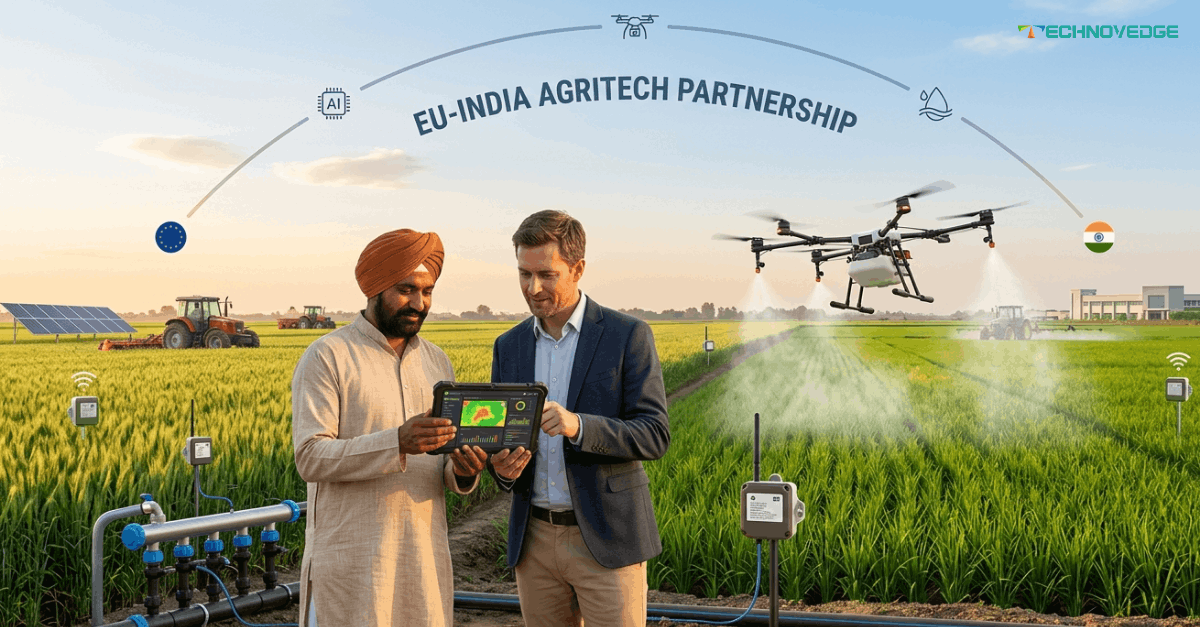
India is becoming one of the agricultural technology marketplaces with the quickest rate of growth in the world. With more than 50% of the population relying on agriculture and more than 146 million hectares of fertile land, the nation is quickly embracing innovations like drone-based farming, precision irrigation, and AI-driven crop analytics.
There has never been a better moment for European agritech SMEs to interact with India’s agricultural revolution. Long regarded as the backbone of India’s food production, Punjab and Haryana are currently dealing with pressing issues like soil degradation, groundwater depletion, and growing input costs, which is driving demand for solutions in data-driven farm decision-making, precision agriculture, and water management.
At the same time, the region is emerging as a key agritech innovation hub. Highly mechanized farming systems, strong agricultural research institutions, and government-backed digital agriculture initiatives are accelerating the adoption of technologies that improve productivity while supporting more sustainable farming.
For European companies specializing in AI, IoT, robotics, and climate-smart agriculture, this shift presents a strategic opportunity. By partnering with local institutions and government programs, SMEs can introduce advanced technologies into one of the world’s largest and most dynamic agricultural markets.
Why UK Agritech Companies Should Enter India Now
India’s agriculture industry is rapidly changing technologically, which presents UK agritech developers with a lot of opportunities. This change is being accelerated by strong government backing, with state and federal programs supporting AI, digital agriculture, and farm-level data platforms. International businesses are finding it simpler to work with local partners and farmers because to these policies, public support, and pilot programs.
At the same time, soil degradation, climate variability, and groundwater depletion are putting more strain on India’s agricultural industry. Demand for technology that increase resource efficiency, such as water-efficient irrigation, soil monitoring, and precision crop management systems, is being driven by these sustainability issues.
Crucially, India’s agritech ecosystem is still in its infancy as compared to Europe, especially when it comes to cutting-edge digital agricultural technologies. Before the market becomes more competitive, this gives UK businesses a great chance to form alliances, conduct pilot projects, and develop strong market positioning.
Key Agritech Trends Transforming Punjab & Haryana
AI-Driven Farming and Crop Intelligenc
Artificial intelligence is increasingly being used to improve agricultural decision-making.
The ANNAM.AI initiative at IIT Ropar is developing AI-based systems that analyze weather data, soil conditions, and crop health to provide real-time recommendations for farmers. Farmers use these systems to optimise irrigation, detect pests early, and reduce input costs. Such technologies are expected to significantly improve agricultural efficiency and sustainability.
Agricultural Drones and Precision Spraying
Drone technology is rapidly becoming part of modern farming systems.
In order to provide drone-based crop spraying services and farmer training programs in several states, Syngenta (Switzerland) has teamed up with IoTechWorld Avigation, an Indian drone company. Large-scale demonstrations and pilot projects are part of the push to encourage the use of drones for precision agriculture and crop protection.Agricultural drones enable aerial crop monitoring, precision pesticide spraying, and detailed field mapping and soil analysis, helping farmers improve efficiency, reduce input use, and make more informed farm management decisions.
In India, the use of precision agriculture technologies, including as sensors and AI analytics, is already growing; early adopters predict yield improvements of 15–20% yield improvements and reduced input costs.
Smart Irrigation and Water Management
Water scarcity has become a major concern for agricultural regions in northern India.
Netafim operates extensively in India with precision drip irrigation systems and digital irrigation solutions designed to improve water efficiency and crop yields.
To increase water efficiency and promote sustainable farming, governments are progressively supporting technology like drip irrigation, IoT-based water monitoring systems, and solar-powered irrigation pumps.
These innovations help farmers reduce water consumption while maintaining crop productivity.
Digital Agriculture Platforms
India is developing a nationwide digital agriculture ecosystem that integrates farmer databases, land records, crop information, and advisory services. Cropin has partnered with global agribusiness companies including Bayer and Syngenta to deploy digital farm management and crop analytics platforms across supply chains in India. These solutions use satellite data, AI, and farm-level insights to help improve productivity, traceability, and risk management.
Digital platforms will enable agritech companies to provide services such as farm management software, digital marketplaces, crop analytics tools, and access to farm credit and insurance.
Government Schemes Supporting Agritech Innovation
European SMEs entering India’s agritech market can leverage several government initiatives designed to support agricultural innovation.
-
Digital Agriculture Mission
Funding and pilot support are available through initiatives linked to the Digital Agriculture Mission. The programme aims to build digital public infrastructure for agriculture using technologies such as AI, machine learning, and big data. While direct subsidies for foreign companies are limited, agritech firms can access opportunities through government-funded pilot projects, public-private partnerships, and state-level digital agriculture programmes that support the deployment and testing of innovative technologies.
-
PM-KUSUM Solar Agriculture Program
Solar-powered irrigation receives substantial financial support from the PM-KUSUM program. Farmers only need to contribute a small percentage of the entire investment because they can receive subsidies of up to 60% of the cost of solar pumps, with an extra 30% accessible through concessional loans. Although farmers are the intended recipients of the subsidy, agritech and energy firms may take part as suppliers of solar irrigation systems, installers, or project developers.
-
Pradhan Mantri Krishi Sinchai Yojana (PMKSY)
By providing funding for micro-irrigation technology like drip and sprinkler systems, PMKSY encourages effective water management. The initiative creates market opportunities for businesses that supply irrigation equipment, precision irrigation technologies, and water management solutions by offering farmers subsidies for implementing water-saving irrigation systems.
-
Skill Development Programs for Agritech
Government-funded training facilities offer courses in fields including agricultural drones, artificial intelligence, robotics, and digital farming technologies as part of national skill development programs like the Skill India Mission. Agritech enterprises can gain from these programs by collaborating with training institutions, gaining access to a trained staff, and taking part in government-funded training and pilot programs, even though they do not directly award funding to businesses.
Market Opportunities for European Agritech SME’
Key Agritech Opportunity Areas in India
India’s agritech ecosystem presents several opportunities for technology providers, particularly in areas that improve farm productivity, resource efficiency, and climate resilience.
Precision Agriculture Technologies
There is growing demand for technologies such as IoT soil monitoring systems, satellite-based crop analytics platforms, and AI-powered farm management software that help farmers make more data-driven decisions.
Drone and Robotics Solutions
Drone and robotics technologies are gaining traction in precision agriculture, particularly for crop monitoring, precision spraying, and automated harvesting, helping farmers reduce labour requirements and improve operational efficiency.
Climate-Smart Farming Technologies
As climate variability increases, technologies that support climate-resilient farming such as climate forecasting tools, carbon-efficient farming solutions, and regenerative agriculture platforms are becoming increasingly important.
Market Playbook: How European Agritech SMEs Can Enter Punjab & Haryana
For European agritech SMEs, a phased and locally integrated approach is often the most effective way to enter the Indian market. Punjab and Haryana provide a strong testing ground due to their advanced farming infrastructure and openness to innovation.
-
Start with pilot projects
Participating in state-backed pilots allows companies to test technologies in real farming conditions while building credibility with farmers and policymakers.
-
Partner with local agricultural institutions
Collaborating with agri-universities and research institutes can accelerate field validation and provide access to established farmer networks.
-
Focus on 1–2 key use cases
Targeting specific challenges, such as irrigation efficiency or soil monitoring, helps demonstrate clear value before expanding into broader solutions.
-
Localise pricing and service delivery
Adapting pricing models, support services, and distribution channels to local farming economics is critical for long-term adoption and scalability.
Future of Agritech in India
Increasing Agritech Investment
Over the past ten years, investment in India’s agritech industry has increased dramatically; between 2020 and 2025, entrepreneurs raised over $2 billion in more than 250 capital rounds. Arya.ag raised around $20 million, Niqo Robotics raised approximately $13 million to create AI-powered agricultural robotics, and Ecozen raised about $30 million in recent deals. These investments demonstrate the significant level of interest among investors in technologies like digital agriculture platforms, climate-smart farming solutions, and AI-driven crop analytics.
A Launchpad for Agritech Innovation in India
Punjab and Haryana are entering a new era of technology-driven agriculture, powered by AI, drones, digital platforms, and precision irrigation systems.
For European agritech SMEs, these states represent a strategic entry point into India’s rapidly expanding agricultural technology market.
With strong government support, growing farmer adoption of technology, and a rapidly evolving agritech ecosystem, the region offers significant opportunities for innovation and collaboration.
Ready to Explore Agritech Opportunities in India?
Technovedge has supported European SMEs in launching pilot programs, forming local partnerships, and navigating India’s regulatory landscape, reducing market entry time from years to months.
📩 Contact us today to explore how your agritech solutions can grow in India.
🔗 Follow us on LinkedIn for ongoing UK–India technology insights