




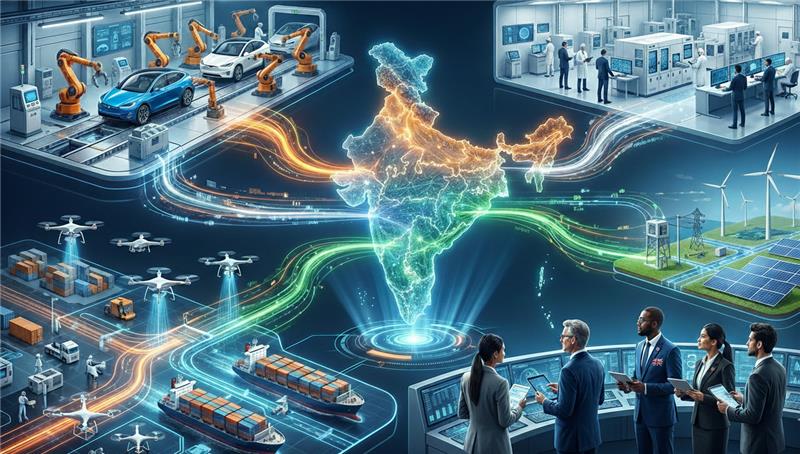
India’s manufacturing sector has moved decisively from potential to performance. What was once an emerging alternative is now a strategic priority for global manufacturers seeking resilient supply chains, scalable production, and long-term market access.
For global manufacturers particularly those from the UK & Europe – India is now more than a market to explore; it’s a strategic destination for sustainable industrial growth. The reasons are compelling: a rising skilled workforce, robust export momentum, deepening foreign investment, and policy frameworks built to deliver scale and innovation.
Momentum Built on Policy, Scale, and Infrastructure
- India has undertaken sustained policy reforms to strengthen its manufacturing base. Flagship initiatives such as Make in India and the Production-Linked Incentive (PLI) schemes have catalysed private investment and accelerated domestic value creation. For global manufacturers, these initiatives translate into faster market entry, improved investment certainty, and reduced execution risk by aligning incentives, regulation, and infrastructure with long-term manufacturing commitments.
- These incentives have helped attract foreign direct investment (FDI), with manufacturing FDI reaching approximately US$19 billion in FY 2024–25, reflecting continued global investor confidence in India’s industrial ecosystem.
- Increasing investor confidence is only part of the story. India’s industrial output has continued to demonstrate strength, with the Index of Industrial Production (IIP) rising to a 26-month high further evidence of sustained manufacturing growth feeding into broader economic recovery.
A Sector Growing in Depth and Output
- Supply Chain Resilience : India’s manufacturing ecosystem is supported by a dense network of MSMEs integral to supply chains. For foreign manufacturers, this depth translates into quicker localisation, supplier diversification, and operational flexibility—reducing dependency risk and time to scale. They account for over 35% of manufacturing output, nearly 49% of exports, and more than 31% of GDP, underscoring their central role in industrial value creation.
- Exports and Global Acceptance: Made-in-India products are gaining traction globally. In FY 2025, Indian manufacturers exported 5.3 million vehicles, signalling rising global demand for Indian automotive products across passenger cars, commercial vehicles, and two-wheelers.
India is also enhancing its capacity in high-value segments such as electronics and wind energy components, where domestic value addition has risen sharply and is projected to continue growing.
- Advanced Manufacturing and Innovation: According to thought leadership from KPMG in India, the country’s manufacturing momentum while notable must now shift toward digital maturity and connected data ecosystems to capture global leadership. Integrating technologies such as automation, IoT, and AI into factory operations will be key to competitiveness, efficiency, and supply chain agility.
KPMG also highlights the importance of robust ecosystems where MSMEs, logistics networks, and integrated data platforms work together as a defining differentiator for global manufacturing leadership.
Why India Matters to Global & UK Manufacturers
India offers a unique combination of market demand, operational scalability, and policy support:
- Expanding domestic consumption: India’s growing middle class is projected to become one of the largest consumer markets in the world, compelling manufacturers to build local capabilities that serve both domestic and export markets.
- Competitive investment climate: With 100% FDI allowed in most manufacturing sectors under automatic approval, India remains competitive in attracting global capital a trend reflected in rising investment inflows year after year.
- Strategic diversification: Companies globally are recalibrating supply chains in response to geopolitical risk and the need for diversification and India’s labour pool, cost structure, and improving infrastructure make it a compelling alternative to traditional sourcing locations.
For UK boardrooms, this confluence of factors makes India not just an investment destination, but a strategic partner in global production one where manufacturing excellence complements broader global ambitions.
Technology and the Future of Manufacturing
Digital maturity will be the defining differentiator for manufacturers operating in India. Companies that integrate automation, IoT, and connected data platforms early will achieve higher efficiency, stronger export competitiveness, and faster scalability.
In sectors from consumer electronics to capital goods, the drive toward connected data and advanced automation is supporting higher quality, improved cost control, and enhanced export competitiveness all of which are crucial for global partnerships.
Turning Strategic Opportunity into Execution
India’s manufacturing momentum is unmistakable. What sets it apart now is the integration of scale, policy, and technology creating an environment where global manufacturers can expand, innovate, and compete on a global stage.
Technovedge works with UK businesses to establish and scale operations in India.
🔗 Follow us on LinkedIn for ongoing UK–India technology insights.